
KEMU Orders 20 Afghan MBBS Students to Complete Departure Formalities Following PMDC Directive
- Internationl
- (Asia/Kolkata)
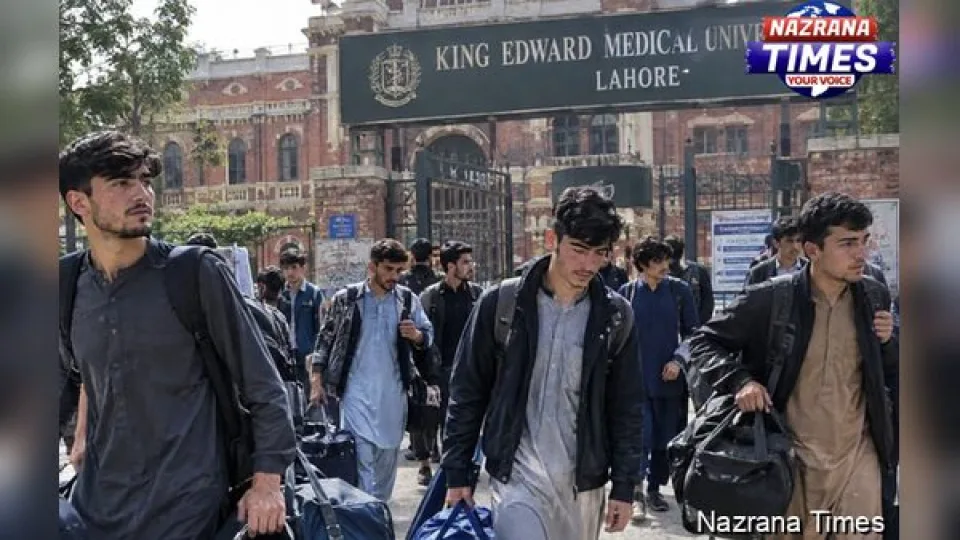
Seven final-year students among those affected as Pakistan medical regulator restricts Afghan admissions and directs institutions to facilitate return of previously enrolled students
LAHORE (Nazrana Times):
King Edward Medical University (KEMU) in Lahore has directed 20 Afghan students currently enrolled in its MBBS programme to complete legal and administrative formalities for their return to Afghanistan, following new instructions issued by the Pakistan Medical and Dental Council (PMDC).
The affected students were asked to report to the Assistant Registrar’s MBBS Office within 24 hours to complete the required procedures.
According to university records cited in media reports, 22 Afghan nationals are associated with KEMU. Of them, 20 are currently enrolled in the MBBS programme, while two have recently completed their medical degrees. Seven of the enrolled students are reported to be in their final year, raising concerns over the disruption of studies for those nearing graduation.
PMDC Directive Restricts Afghan Medical Admissions
The KEMU action follows a PMDC communication dated September 1, 2026, sent to medical and dental institutions across Pakistan.
Under the directive, Afghan nationals already enrolled in medical or dental programmes are required, in accordance with prevailing policy directions, to return to Afghanistan. Institutions have been instructed to complete the necessary administrative formalities, including issuing No Objection Certificates (NOCs), and facilitate their departure.
The regulator has also barred new admissions, placements, transfers and migrations of Afghan nationals in medical and dental institutions during the current academic session until further orders.
The September directive reportedly reiterates instructions first issued by the PMDC on July 31.
Decision Comes Amid Strained Pakistan-Afghanistan Relations
The development comes against the backdrop of sharply strained relations between Islamabad and Kabul.
Pakistan has repeatedly accused the Afghan Taliban authorities of allowing the banned Tehreek-e-Taliban Pakistan (TTP) and other militant groups to operate from Afghan territory and carry out attacks inside Pakistan.
The Afghan Taliban government has denied allegations that it permits Afghan territory to be used for attacks against Pakistan.
Tensions escalated significantly during 2026, including cross-border military confrontations.
In February, Director General Inter-Services Public Relations Lieutenant General Ahmed Sharif Chaudhry said during a military briefing that 274 Afghan Taliban combatants had been killed during Pakistan’s Operation Ghazab lil-Haq. He also said 12 Pakistani soldiers had lost their lives and 27 had been injured during the operation.
These figures represent the Pakistani military’s official account of the confrontation.
Terrorism Toll Has Risen Sharply in Pakistan
Pakistan has experienced a substantial increase in militant violence in recent years.
According to the Pakistan Institute for Conflict and Security Studies (PICSS), 580 civilians were killed in militant violence and counter-militancy-related incidents during 2025, compared with 468 in 2024. PICSS described 2025 as the deadliest year for civilian casualties since 2015.
The security situation remained serious during 2026. PICSS recorded 463 civilian deaths during the first seven months of the year, alongside hundreds of deaths among security personnel and militants.
Pakistan’s Foreign Ministry has also maintained that terrorist activity originating from Afghan territory has caused significant civilian casualties in Pakistan. Kabul disputes Pakistan’s broader allegations concerning militant sanctuaries on Afghan soil.
Bajaur Attack Further Deepened Tensions
Relations deteriorated further following a deadly attack on a security post in Bajaur district on February 16, 2026.
The attack killed 11 Pakistani security personnel as well as a child. Pakistan subsequently summoned Afghanistan’s deputy head of mission and issued a formal diplomatic protest.
Pakistan’s Foreign Office said it had serious concerns over TTP militants allegedly operating from Afghan territory and demanded that the Taliban authorities take “immediate, concrete and verifiable” measures against militant groups.
The TTP claimed responsibility for the Bajaur attack. Pakistan maintains that the group operates from sanctuaries in Afghanistan, while Kabul denies allowing its territory to be used for attacks against Pakistan.
Foreign Office Clarifies Immigration Position
Foreign Office spokesperson Sajjad Haider Khan has said that under Pakistan’s Illegal Foreigner Repatriation Plan (IFRP), any foreign national staying in Pakistan without a valid passport and visa is liable to deportation.
At the same time, he clarified that Pakistani authorities continue to process visa-extension applications submitted by Afghan students in accordance with existing policies, rules and regulations.
This distinction is significant because the PMDC directive concerns medical and dental education, while an individual student’s immigration status is also governed by Pakistan’s visa and immigration regulations.
Rights Groups Raise Concerns
The decision has drawn criticism from human rights organisations.
The Human Rights Commission of Pakistan (HRCP) has described the situation as a humanitarian crisis affecting students whose education and future could be placed at risk.
Human Rights Watch has also raised serious concerns, particularly regarding Afghan female medical students. The organisation said returning women to Afghanistan could effectively prevent them from continuing medical education because of restrictions imposed by the Taliban authorities on women’s higher and medical education.
The Afghan Embassy has also objected to the move and appealed for students already studying in Pakistan to be allowed to complete their education.
The controversy therefore presents Pakistan with two competing considerations: the government’s national policy and immigration framework concerning Afghan nationals, and concerns over the educational and humanitarian consequences for students who had already been admitted to Pakistani institutions.
Wider Repatriation Policy
Pakistan began implementing its Illegal Foreigners Repatriation Plan in late 2023, initially focusing on undocumented foreign nationals, the overwhelming majority of whom were Afghans.
The policy has since expanded as relations between Pakistan and Afghanistan have deteriorated.
The latest PMDC directive represents a significant development because its impact extends to Afghan nationals already enrolled in professional medical and dental programmes, including students who are close to completing their degrees.





Leave a Reply