
Dussehra Celebrated with Devotion at Karachi’s Swami Narayan Mandir, Ravana Effigy Burned
- Internationl
- (Asia/Kolkata)
Karachi Ali Imran Chattha
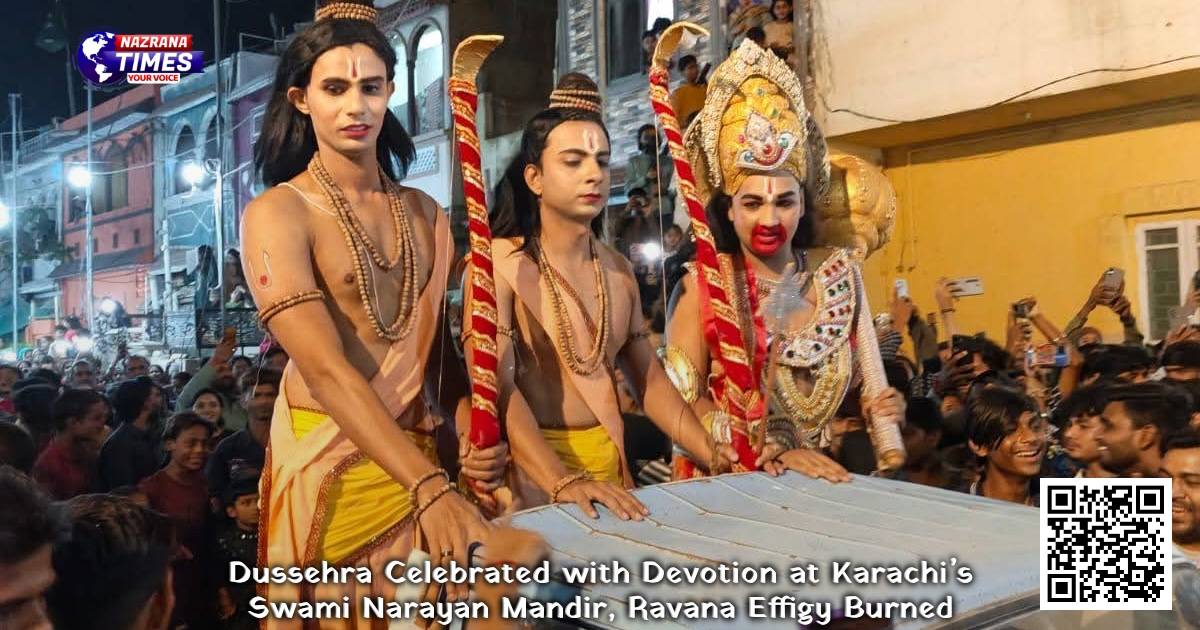
Dussehra was celebrated with religious devotion and enthusiasm at the historic Swami Narayan Mandir in Karachi, Pakistan. Men, women and children participated in large numbers. The nine-night Navratri festival concluded with Vijay Dashami and Dussehra, featuring special prayers and aartis for Mata Durga, prayers for national peace and prosperity, and the unfurling of the Pakistani national flag.
Dussehra is observed on the tenth day following the nine nights of Navratri. The Ramayana is also recited during Navratri, while Dussehra commemorates Lord Ram’s victory over Ravana. In Hindu tradition, Vijay Dashami symbolises the triumph of good over evil. The festival marks both Mata Durga’s victory over Mahishasur and Bhagwan Ram’s victory over Ravana. Garba and Dandiya dances added a cultural dimension to the celebrations, allowing the Hindu community to express its religious and cultural traditions.
History of Pakistan’s Only Swaminarayan Temple
Located on Muhammad Ali Jinnah Road, opposite the KMC Building and behind the market, Swami Narayan Mandir is the only Swaminarayan temple in Pakistan. It celebrated its 150th anniversary in April 2004.
According to local tradition, the distinction between Hinduism and Sikhism is not clearly defined in Sindh, which is why a Gurdwara also exists within the same compound. Members of the Hindu community live in the surrounding area, and many are descendants of families who lived in Karachi before Partition. The small houses in the neighbourhood reflect the residents’ modest financial circumstances. However, on the occasion of the festival, people appeared cheerful and wore their best clothes.
The temple also holds considerable historical significance. In 1947, it became a refugee camp where people from across Sindh who wished to settle in India waited for their departure by ship. Muhammad Ali Jinnah, the founder of Pakistan, visited the temple during this period.
In 1989, a group of sadhus from the Shree Swaminarayan Mandir in Ahmedabad visited the temple for the first time since independence. The temple also houses a sacred cowshed within its premises. It is believed that Muslims, along with Hindus, visit the temple, adding to its significance. The temple management also organises mass weddings for economically disadvantaged couples. In 2008, arrangements were made for the mass wedding of 20 poor couples.
Dussehra Celebrations Have Drawn Large Crowds for Decades
The temple’s Dussehra celebrations have historically attracted large crowds. A 1950 report by Dawn noted that the largest gathering was at Swami Narayan Temple, where Dr Sita Ram, India’s High Commissioner in Pakistan, spoke about the significance of Dussehra.
Political leaders have also participated in the celebrations in recent years. On 19 October 2026, senior MQM-Pakistan leader and MNA Dr Farooq Sattar visited Swami Narayan Mandir and Narayanpura Mandir. He extended heartfelt greetings to the Hindu community on its religious festival and assured them of his party’s full cooperation in their joys and sorrows.
Ravana Effigy Burned During the Celebrations
During the ceremony, a young child was dressed as Lord Ram and carried a bow. A procession featuring Ram, his brother Lakshman and his friend Hanuman first circled the temple.
Previous reports by Dawn have also described similar celebrations, during which performers dressed as deities rode in a blue Suzuki pickup amid cheers, waving to the crowd before coming face to face with the effigy of Ravana.
Building the effigy is a community effort. On one occasion, children from the neighbourhood spent six days constructing a structure more than 36 feet tall. Bamboo was used for the main frame, hay for the stuffing and cloth for the outer covering.
The temple management selects the children who play Ram and Lakshman. Only those who have actively participated in the festival since childhood are chosen for these roles. Once selected, they receive two days of training in aiming and shooting the burning arrows.
At the climax of the ceremony, the child portraying Ram was given fiery arrows and shot them at Ravana’s effigy. The effigy caught fire on the third arrow, drawing an enthusiastic response from those gathered to watch.
The burning was accompanied by applause, whistles, laughter and bhajans praising Ram and Lakshman. The message conveyed was that the destruction of evil is not a cause for sadness and that everyone is welcome to witness the symbolic victory of good over evil.
Participants said Dussehra is not merely a religious festival but also an occasion for joy, devotion and community gatherings. The celebration symbolically represents the victory of good over evil.


Leave a Reply