
Pakistan Adopts Ishrat Hussain’s Reform Recommendations as Basis for Institutional Restructuring: Aurangzeb
- Internationl
- (Asia/Kolkata)
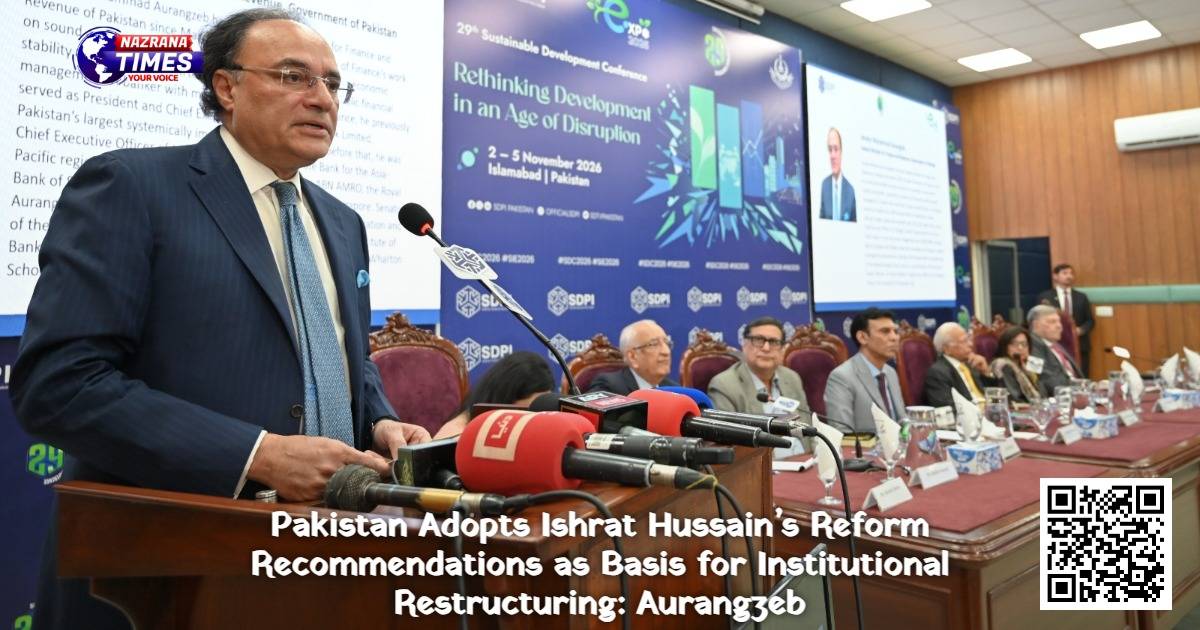
ISLAMABAD (Nazrana Times): Finance Minister Muhammad Aurangzeb said on Tuesday that Pakistan’s government had adopted former State Bank governor Dr Ishrat Hussain’s institutional reform recommendations as the basis for its restructuring agenda. He credited Hussain with transforming the country’s banking sector and laying the groundwork for broader governance reforms.
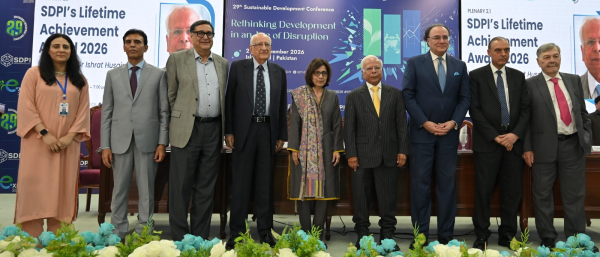
Aurangzeb was speaking at a ceremony organised by the Sustainable Development Policy Institute (SDPI) to present Hussain with a Lifetime Achievement Award. He said the government was building on work begun by previous administrations.
Government to Implement Reforms in Phases
The finance minister said he had approached Hussain directly for his institutional reforms report and used it as the basis for the government’s restructuring plans. The main change, he said, was to implement the recommendations in phases because of the number of ministries and attached departments involved.
Speakers Recall Hussain’s State Bank Reforms
State Bank Governor Jameel Ahmed paid tribute to Hussain’s contribution to Pakistan’s socioeconomic development and financial sector. Recalling their first professional interaction in December 1999, Ahmed said Hussain arrived at the central bank with a clear vision and an ambitious plan for reform. Over the next six years, Ahmed said, Hussain introduced some of the most extensive changes in the bank’s history.
Former federal minister and commerce adviser Abdul Razak Dawood said the award was a fitting recognition of Hussain’s work at the State Bank. Habib Bank Limited Chairman Sultan Ali Allana highlighted Hussain’s combination of civil service experience and international financial expertise.
Nargis Sethi, a former secretary to the prime minister, recalled working closely with Hussain when he chaired the National Commission for Government Reform, established in 2006. Dr Adil Najam, dean emeritus and professor at Boston University’s Pardee School of Global Studies, said aspects of Hussain’s legacy often received less attention than his achievements as a policymaker
Bangladesh Adviser Calls for a New South Asian Development Model
Earlier, Rashed Al Mehmud Titumir, the Bangladeshi prime minister’s adviser on finance and planning, called for closer cooperation between Bangladesh and Pakistan. He proposed a South Asian development model based on industrial transformation, regional production networks, decent employment and stronger social protection.
Titumir said changes in the international economic and political order were reshaping how developing countries could industrialise, create jobs, mobilise domestic resources, finance development and protect their economic sovereignty. He urged those countries to rethink conventional strategies and strengthen their ability to withstand economic shocks.
Bangladesh, he said, aimed to use its geographical position to become a manufacturing hub and a gateway for exports.
Malik Calls for Investment Without Additional Borrowing
Federal Minister for Climate Change and Environmental Coordination Musadik Malik said Pakistan would no longer rely on additional borrowing to finance development. He said the country remained open to equity investment and debt swaps, and called for development that was equitable, durable and shaped by Pakistan’s own priorities.
Malik said Pakistan collected around PKR 16 trillion in revenue, of which approximately PKR 8 trillion went to debt servicing. He put that share at roughly 48–49% of total revenue.
$10 Million Green Field Programme for Young People
Malik proposed using artificial intelligence to create jobs for young people. He suggested that graduates could help train AI systems in languages including Balochi, Brahui, Sindhi and Urdu.
He also announced a $10 million Green Field programme to provide young people with equity investment for scientific experiments and innovative projects. The first competition is planned within three months.
SDPI Executive Director Abid Qayum Suleri, SDPI Board of Governors Chairman Shafqat Kakakhel and Allama Iqbal Open University Vice-Chancellor Nasir Mahmood addressed the inaugural session. They stressed the importance of sustainable development, regional cooperation and adapting development strategies to emerging global challenges. Federal Minister for Planning, Development and Special Initiatives Ahsan Iqbal also spoke on the occasion.





Leave a Reply