
SAARC Journalists stress the need to establish peace in South Asia
- Internationl
- (Asia/Kolkata)
New Delhi Ali Imran Chattha Nazrana Times
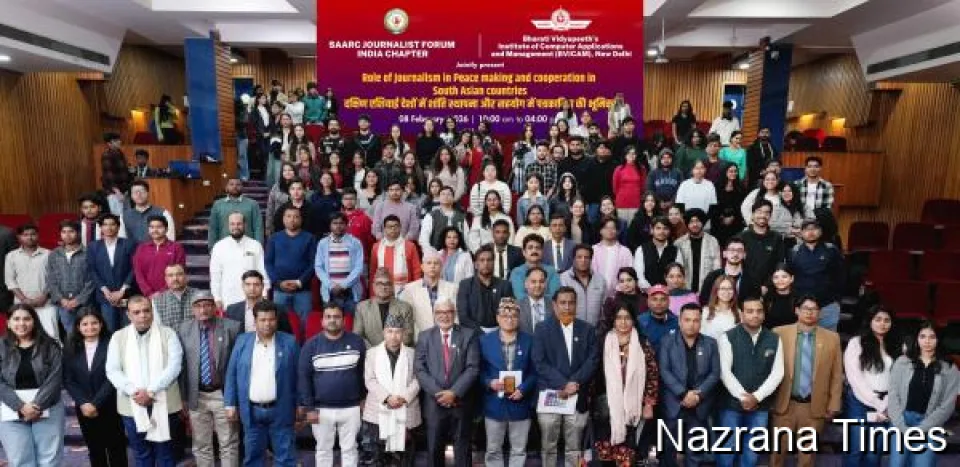
An extensive discussion has been held between journalists from Nepal, India, Sri Lanka, Bangladesh, Pakistan, Bhutan, and other countries at the International Conference on the Role of Journalism in Peacebuilding and Cooperation in South Asia organized by the Bharatiya Vidyapeeth and the SAARC Journalists Forum India Chapter in New Delhi, India.
The program, chaired by Professor MN Hoda, Director of the Bharatiya Vidyapeeth, was addressed by the International President of the SAARC Journalists Forum Raju Lama, General Secretary Md. Abdur Rahman, Member Ismita Mishra, President of the Sri Lanka Chapter Rahul Samantha, President of the India Chapter Aniruddha Sudhanshu, and others.
At the program, the international members of the Forum, Rinzin Wangchuk of Bhutan and General Secretary of the Pakistan Chapter Husnain Chaudhary, addressed the program through a video message.
The speakers participating in the program emphasized that despite the challenges, efforts should be made through journalism to establish peace in the SAARC region through the medium of journalism.
Meanwhile, at the event, the third annual Kishore Shukla International Journalism Award 2026 established by the SAARC Journalists Forum India Chapter, has been presented to Nepal's Nripendra Lal Shrestha, India's Shashibhushan Kumar, and Sri Lanka's Janaka.
Senior Journalists Raju Lama, Abdur Rahman, Rahul Samantha, Noor Nabi, Md Yosuffudin, Rudra Subedi, Saddab Malik, Dipendra Prajapati, Shailesh Sah Kanu, Abhilash Gupta, and Azmat Ali among others were also presented with international journalism awards at the event.




Leave a Reply