
Bilawal Calls for Political Reset, Electoral Reforms and Press Freedom to Restore Public Trust
- Internationl
- (Asia/Kolkata)
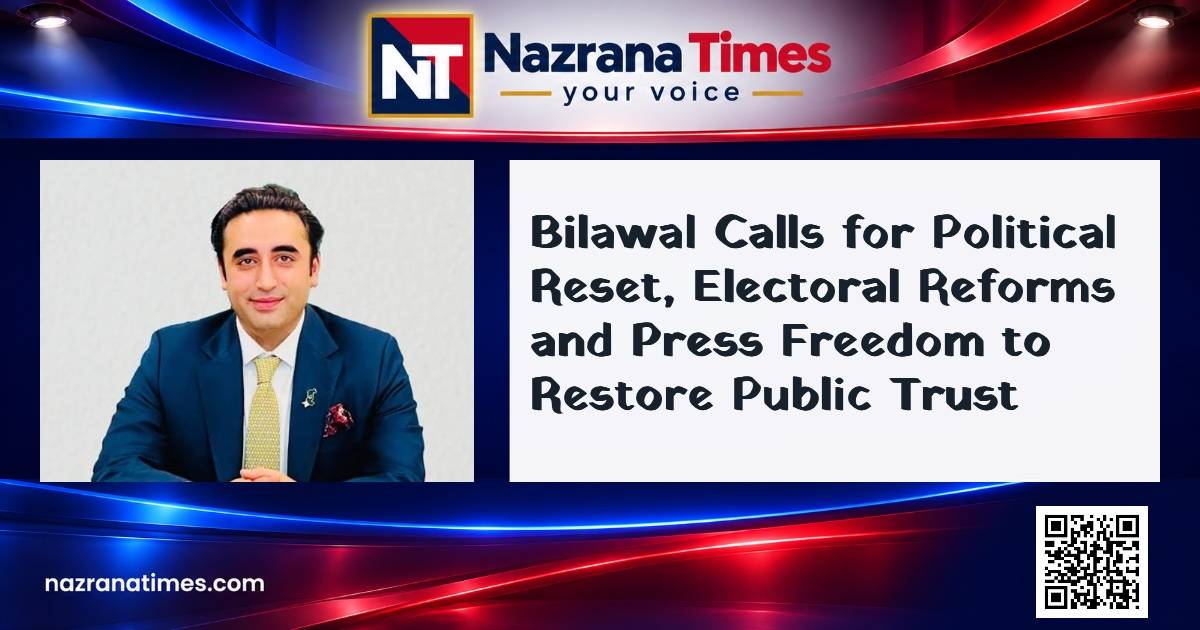
KARACHI, November 17: Pakistan Peoples Party (PPP) Chairman Bilawal Bhutto Zardari has called on all political forces to adopt a joint democratic course to address Pakistan’s present and future challenges. He urged stronger parliamentary institutions, a free media, a credible Election Commission, impartial accountability and judicial reforms supported by broader political consensus.
Addressing journalists at the Karachi Press Club and later answering their questions, Bilawal said the country’s system had not collapsed suddenly on its own but had been brought down. He argued that every institution had lost public trust and that restoring confidence required a comprehensive political reset.
He stressed that confidence in future elections could not be restored without electoral reforms and said the return of reserved seats to the opposition should also be considered.
Journalists Invited to Submit Press Freedom Proposals
Bilawal said the media and journalists were perhaps weaker under the present circumstances than at any other time in Pakistan’s history. Without press freedom, he said, genuine democratic dialogue, dissent and open debate on public issues could not take place.
If journalists had to consider whether speaking the truth or highlighting public problems could lead to action against them under PECA, ACTA or other laws, the media would be unable to fulfil its basic role, he said.
He invited the Karachi Press Club and journalists nationwide to prepare proposals on media freedom, journalists’ protection, and the legal and professional difficulties they faced. He said the PPP would raise these concerns in Parliament.
Economic Hardship and Confrontational Politics
The PPP chairman said Pakistan had experienced many difficult periods, but the current economic situation was deeply worrying. Given the pace of rising poverty, unemployment and inflation, he feared people’s hardships could increase further.
He regretted that politicians remained occupied with confrontation and the politics of hatred and division, diverting attention from citizens’ actual problems. Although people were discussing the system’s collapse, he said, there was little serious debate about why it had reached this point or the underlying causes of its failure.
Bilawal said a reset was essential, but it must be political rather than non-political. Politicians represented the people, he said, and their basic problems could only be resolved through democratic and political processes.
“I Share the Responsibility”
He said the process must begin with acknowledging personal mistakes and responsibilities.
“I would like to begin with this: I have a hand in this too, I share the responsibility, I have made mistakes, I am also at fault, I am also responsible. First of all, we must be ready to accept that human beings make mistakes, but the time has come to correct those mistakes now.”
Bilawal said Parliament, the Election Commission, the judiciary and the media had all lost public trust and credibility. Moving the country forward required restoring confidence in these institutions through broad national dialogue and collective effort, he added.
Opposition Criticism Must Be Answered Through Debate
He described Parliament as the country’s decision-making body, where debate, dialogue and differences of opinion belonged. The opposition’s role in any parliament was among the most patriotic and important, he said.
When a government questioned opposition members’ patriotism merely because they criticised its actions, it did a grave injustice to Parliament, democracy and the country, he argued.
Government and opposition should engage in sharp debate and disagreement, but through words and arguments rather than bullets, guns, arrests or threats of imprisonment. Democracy allowed competing parties to present their positions and, through consultation, find a middle path better suited to resolving public problems, he said.
Bilawal said senior politician Maulana Fazlur Rehman had a democratic and political right to criticise the government. Such criticism should be answered through argument and dialogue, not arrests, National Accountability Bureau (NAB) action or other pressure tactics.
He urged the government to hear the concerns of all political parties, including Maulana Fazlur Rehman, and restore their confidence in Parliament. He also described Imran Khan and his party as a political reality and an important stakeholder in the country.
Electoral Reforms and Political Prisoners
To rebuild opposition confidence in Parliament, Bilawal said allegations of election rigging must first be addressed seriously. Disputed elections inevitably raised questions about the Parliament emerging from them, he said.
Alongside electoral reforms, he called for an end to political victimisation. He alleged that NAB had been used as an instrument of political revenge and said parliamentarians should not fear accountability proceedings for voting on legislation or speaking in the House.
He insisted that Pakistan should have no political prisoners. Describing a recurring tragedy in the country’s political history, he said those who became prime minister eventually went to jail, while those imprisoned later reached the Prime Minister House. This cycle must end, and efforts should be made to secure the release of political prisoners, he said.
Joint Action Against Terrorism
Bilawal described terrorism as a serious national challenge requiring unity. If most PTI leaders had been willing to cooperate against terrorism but the process had been sabotaged for some reason, the government should approach the opposition again and resume discussions from where they had stopped, he said.
He urged the government to make the opposition a partner in national matters.
Credible Elections and Impartial Accountability
Bilawal said a political, democratic and people-centred reset required reviewing the Election Commission, accountability institutions and judiciary alongside Parliament and the media. Elections would not achieve their intended purpose until citizens and political parties regained confidence in the Election Commission, he argued.
He described corruption as a fundamental problem but said accountability institutions had repeatedly been used for political revenge. Instead of using NAB as a weapon, Pakistan needed an effective and impartial system capable of addressing actual corruption.
He said corruption was often attributed only to politicians, although bureaucrats and relevant officials also played roles in processing government projects and files. Modern technology and digitisation could help reduce corruption and improve transparency, he added.
Bilawal Questions Lack of Consensus on 27th Amendment
On the judiciary, Bilawal said a system could not be effective or credible if only the government trusted it while the opposition, lawyers or judges themselves remained dissatisfied.
He said the 1973 Constitution and the 18th Amendment had succeeded because they enjoyed broad agreement among political parties and the public.
He said he had worked day and night to secure the 26th Amendment’s passage through mutual agreement, even without complete consensus. By contrast, he said, the 27th Amendment had been passed neither through political consensus nor mutual agreement, but through “brute majority.”
Forced Division of Sindh Rejected
Responding to questions, Bilawal said the PPP supported creating provinces in accordance with the Constitution, the law and the wishes of the people, but would reject unconstitutional or forced measures.
He warned that any forced attempt to divide Sindh, including Karachi, could create dangerous divisions throughout society. Tensions arising from a division against the wishes of Sindh’s people would not remain confined to Karachi but could affect Hyderabad, Mirpurkhas, Tando Allahyar, Nawabshah and other cities, he said.
He said the PPP would not support any initiative that caused clashes or divisions among Sindh’s people.
Answering another question, Bilawal said referendums in Pakistan had mostly served undemocratic purposes. Since the Constitution and law prescribed a clear procedure for creating provinces, he said it would be wrong to pursue an unconstitutional route or a referendum.
No Discussions on Federal Status for Karachi
Asked about meetings with the prime minister and proposals to make Karachi a federal territory or place Karachi, Gwadar and Islamabad under a joint arrangement, Bilawal said he had discussed none of these matters with either the prime minister or the President of Pakistan.
If the prime minister’s cabinet had taken no decision, he said, conclusions should not be drawn solely from reports circulating in the media.
Bilawal appealed to the Karachi Press Club and press clubs nationwide to invite all political parties, organise seminars and dialogues, and question politicians directly to begin a serious national debate on the country’s problems.
He said the way out of the crisis lay in democracy, dialogue, consensus and addressing public problems rather than political revenge, hatred and division.
Chief Minister Murad Ali Shah, provincial ministers, representatives of journalists’ organisations and a large number of journalists attended the event.



Leave a Reply